Online Quizzes and Electronic Certificates
Seven question types with automatic marking, assignments you review by hand, and branded certificates that issue themselves the moment a learner passes.
Start free
A course without assessment is a set of videos. It may be excellent, and the learner still finishes with no way to know whether they understood any of it, and no way to show anyone else that they did.
Those are two separate needs and they are usually met by two separate tools. Assessment gets done in a free form service, the results arrive in a spreadsheet, and the certificate is a design file edited by hand, one learner at a time, until a name is misspelled or a hundred people finish in the same week and it stops being possible.
Here the quiz, the grade and the certificate are one system. The certificate can issue automatically because the platform already knows the score, and the learner has it within seconds of passing rather than whenever somebody gets round to it.
What assessment has to do
Four jobs. Split across a form tool and a design file, the last two never quite happen.
Ask the right kind of question
Seven types, from single choice to long-form written answers, in one quiz.
Mark it without your evening
Closed questions grade themselves on submit. Only the written ones reach you.
Set real conditions
Time limits, attempts, a pass mark and shuffled questions, per quiz.
Prove it afterwards
A designed certificate with a serial number, issued on the condition you choose.
From a question bank to a certificate in a learner’s hands
- 01
Write the questions
Build a bank once, mixing the types you need, and reuse it across quizzes and cohorts.
- 02
Set the rules
Time limit, attempts, pass mark, shuffling, and whether answers are revealed afterwards.
- 03
Design the certificate and let it issue
Place the dynamic fields, choose the condition, and it goes out automatically from then on.
What is included
One system, so the certificate can depend on the quiz result without an integration in between.
- Seven question types, including matching and fill in the blank
- Automatic marking for every closed question type
- Reusable question banks, with a random subset per attempt
- Time limits, attempt limits, pass marks and shuffling
- Assignments with file uploads, revision history and your comments
- A certificate designer with your background, logo and signature
- Dynamic fields for name, course, date, grade and serial number
- Automatic issue on course completion or on passing a quiz
Assessment, and the proof that follows it
Quizzes that mark themselves, written work you review, and a certificate that issues on the condition you set.
Quizzes built from multiple question types
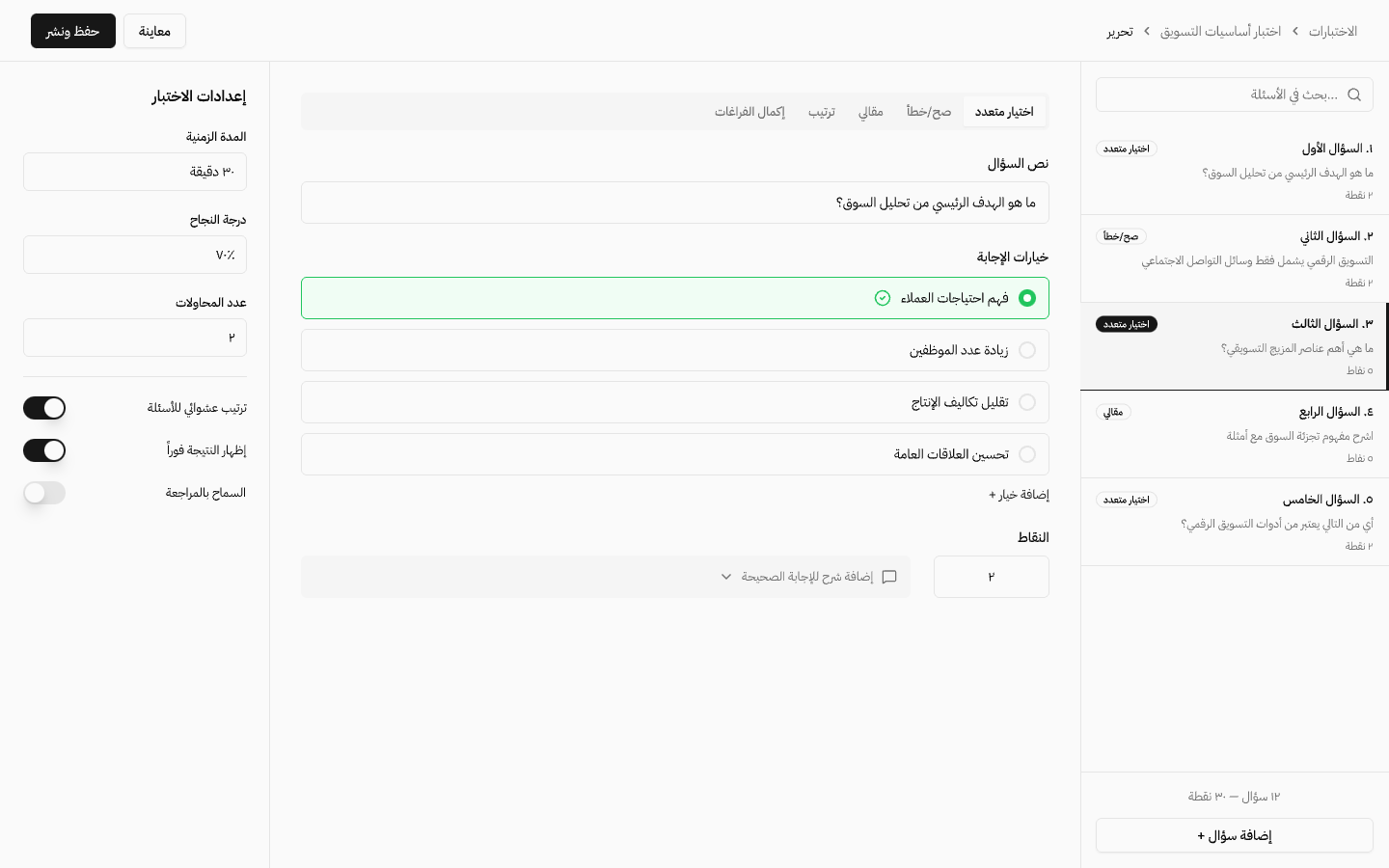
Single choice, multiple choice, true or false, short answer, fill in the blank, matching, and long-form paragraph answers. The closed types grade themselves.
- Question banks you reuse across courses
- Automatic grading for closed questions
- Written answers come to you for review
Assignments for work a quiz cannot measure
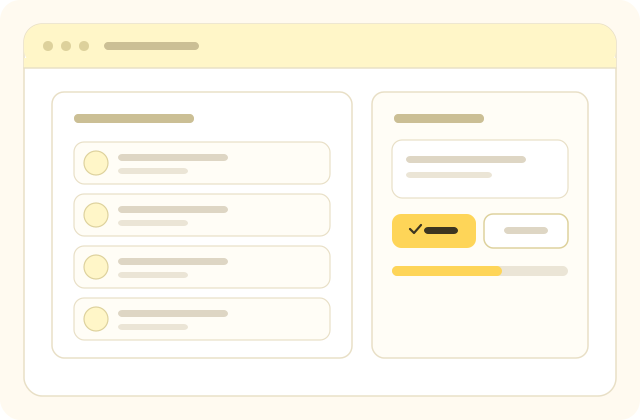
Learners submit, you review, and you either approve the submission or score it against points. Submissions keep their revisions, so a returned piece of work shows what changed.
- Graded by approval or against points
- Revision history kept on every submission
Certificates you design once and issue automatically
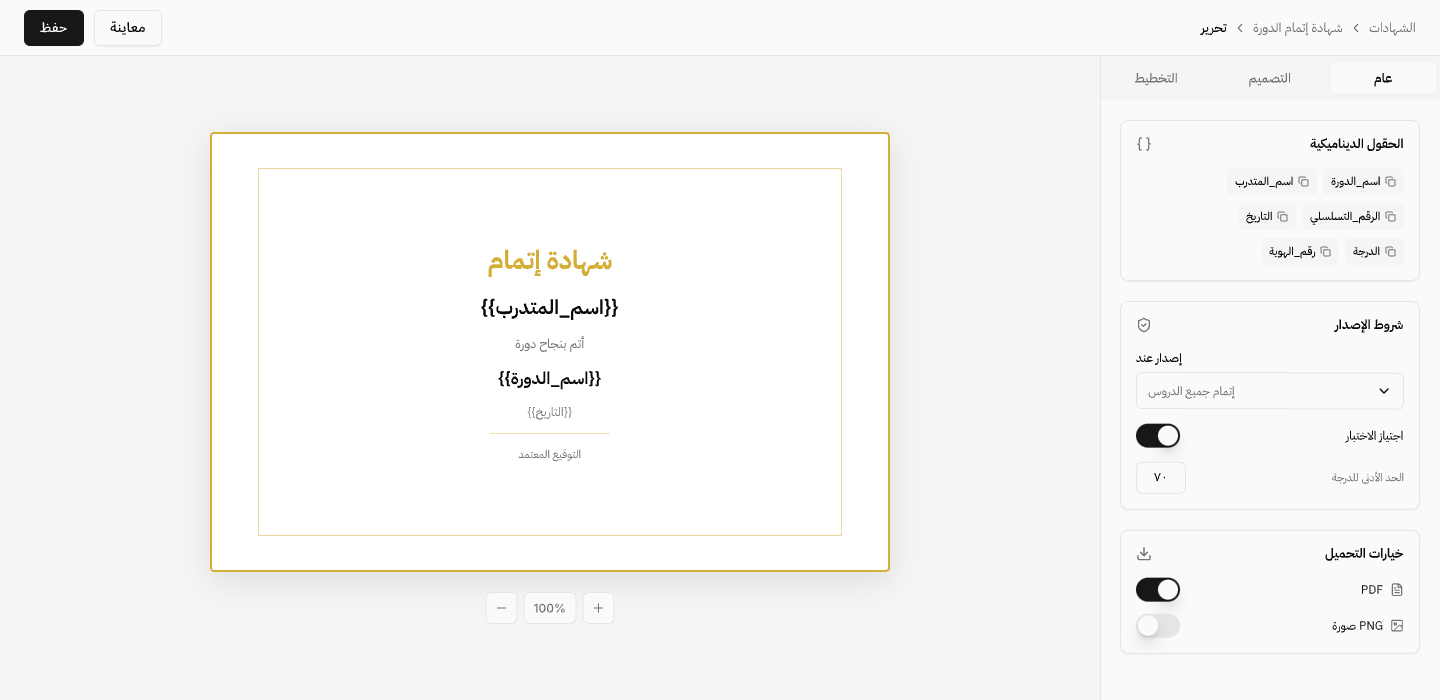
Build the certificate on a canvas, drop in dynamic fields for the learner name, course, date, grade and serial number, then set the condition that triggers it.
- Dynamic fields for learner, course, date, grade and serial number
- Issue on finishing every lesson, or on passing the quiz at a grade you set
- Downloaded as PDF or PNG, carrying your own branding
Learner progress reports
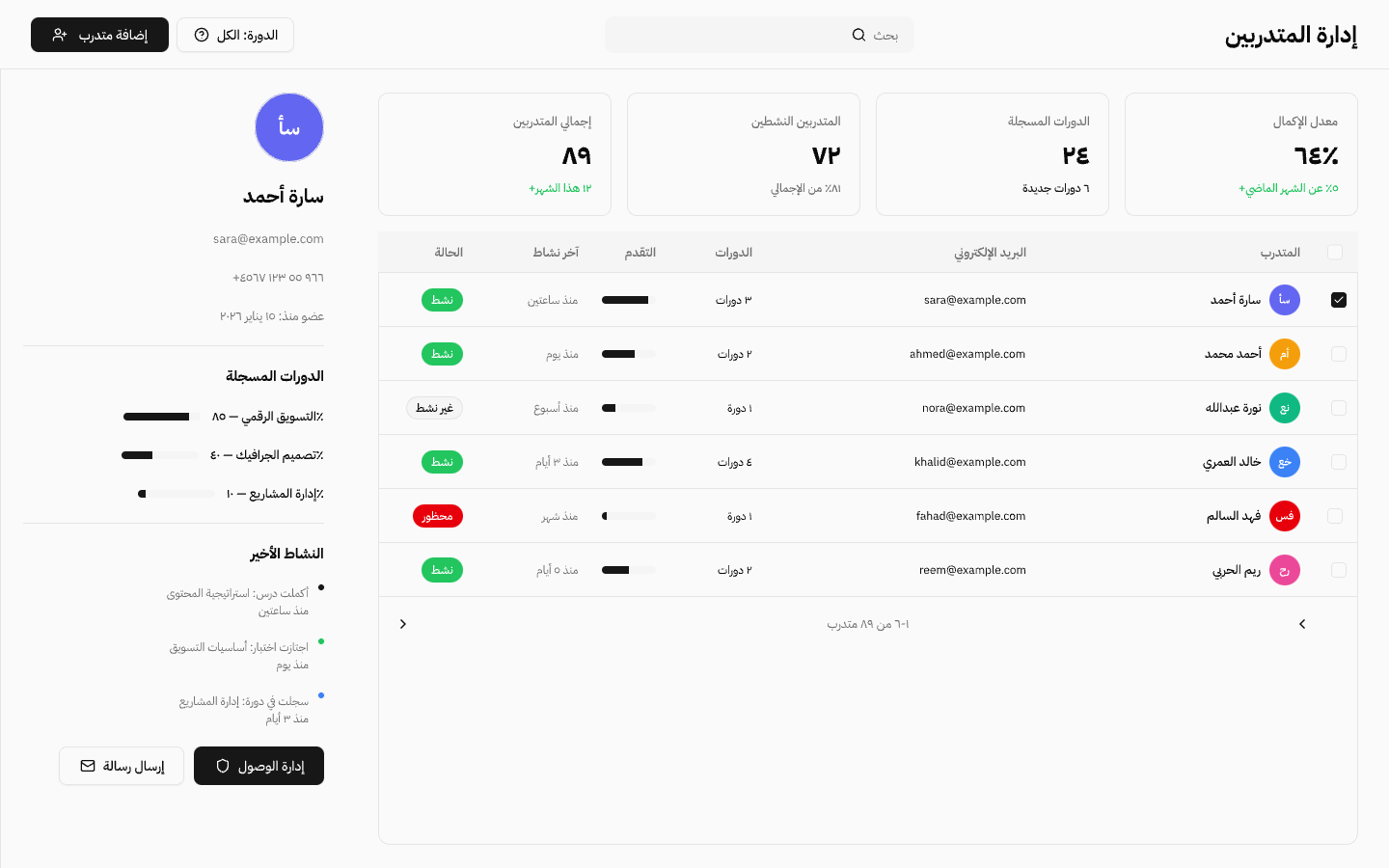
View completed lessons, quiz scores and where each learner stopped, so you can identify content that needs improvement.
- Per-learner progress and completion
- Quiz scores in the same view
Seven question types, and the closed ones mark themselves
Single choice, multiple choice, true or false, short answer, fill in the blank, matching, and long-form written answers. The first six are marked the moment the learner submits, so a cohort of three hundred costs you no marking time at all.
Written answers come to you instead, with the learner and the question in front of you and a place to leave a comment. That split is deliberate: the questions worth a human reading are the minority, and they are the only ones you should be spending an evening on.
Questions live in reusable banks rather than inside one quiz. A bank written for a foundation course can supply the end-of-chapter quiz, the final exam and next year’s cohort without being retyped, and you can pull a random subset per attempt so two learners sitting together do not see the same paper.
The rules that make a quiz an exam
A quiz is only assessment if the conditions are real. Set a time limit, a number of allowed attempts, a pass mark, and whether the questions or the options are shuffled. Decide whether the learner sees the correct answers afterwards, and whether they see them before or after the final attempt.
Those settings are what separates a practice quiz at the end of a chapter from a final exam that a certificate depends on, and both belong in the same course. You can use one of each without installing anything or moving to a second tool.
Certificates designed once, issued automatically
You design the certificate on a canvas: your background, your logo, your signature, and dynamic fields placed where you want them. The learner name, the course title, the completion date, the grade and a unique serial number are filled in at the moment of issue.
Then you set the condition. Issue on finishing the course, or on passing a specific quiz at a mark you choose. From that point it is automatic, and the learner downloads it as a PDF or an image from their own account without asking you for it.
The serial number is the part institutional buyers ask about. Every issued certificate carries one, so a company checking whether an employee genuinely completed the programme has something to check against rather than a picture that could have been made in any design tool.
Arabic names on an Arabic certificate
A certificate template designed around English names breaks the first time it meets a full Arabic name. The text runs the wrong way, the line breaks in the wrong place, or the name simply overflows the space left for it.
These templates are built right to left, and the fields are laid out for Arabic names at the length Arabic names actually are. It is a small thing until you have issued four hundred of them, and then it is the whole difference between a document a learner is proud to share and one they quietly do not.
Common questions
- What question types can I use?
- Single choice, multiple choice, true or false, short answer, fill in the blank, matching, and long-form written answers. Everything except the written type is marked automatically.
- Can quizzes be marked automatically?
- Yes, for all closed question types, at the moment the learner submits. Written answers are held for you to review, with the learner’s response and a place to comment.
- Can I stop learners sharing answers with each other?
- You can shuffle the questions and the options, draw a random subset from a larger bank so two learners see different papers, set a time limit, and cap the number of attempts.
- Can I design the certificate myself?
- Yes. You upload your own background, place your logo and signature, and position dynamic fields for the learner name, course, date, grade and serial number. The design is made once and used for every learner.
- When is a certificate issued?
- On the condition you set: completing the course, or passing a particular quiz at a mark you choose. It then issues automatically and the learner downloads it from their own account.
- Can a certificate be verified?
- Every issued certificate carries a unique serial number recorded against the learner and the course, so an employer or an institution has something concrete to check rather than an image.
- Do certificates work properly with Arabic names?
- Yes. The designer is right to left and the templates are laid out for Arabic names at their real length, so long names do not overflow or break the layout.
- Are the certificates accredited?
- They are your certificates, issued under your brand, and they are not accredited by an external body. If your buyers require accreditation from a specific authority, that accreditation is something you hold, and the platform issues the document that carries it.
Explore more of the platform
- Sell online courses
- Sell digital products
- Sell memberships and subscriptions
- An Arabic learning management system
- Build your website and its pages
- For coaches and consultants
- For educators and training centres
- For creators building an audience
- For organizations and corporate training teams
- How selling a course actually works
- Compare Lymonah with other platforms
- Everything the platform does
- See pricing